950 buyer-intent observations across four AI engines. 47 days of continuous measurement. A sub-$10M nationwide blueprint printer becoming Perplexity's #1 recommendation in a category dominated by FedEx Office and ARC Document Solutions. This is what the platform saw — before any other tool could see it.
Azul Prints sells online blueprint and large-format printing nationwide. Same-day print on orders before noon, UPS shipping anywhere in the US, ARCH D drawings on professional bond. The product is excellent. The category is commoditized. And in 2026, the buyer's first move stopped being Google.
Architects, general contractors, and real estate developers needing prints fast started asking ChatGPT, Perplexity, and Gemini. The answers were the same three names: FedEx Office, Staples, ARC Document Solutions. Big incumbents with billion-dollar revenues and decades of brand mass.
Azul Prints — faster, cheaper, more specialized — was nowhere in the answer. This is the kind of category Rankovi.ai exists to measure.
In the platform's earliest measurements — local dev runs before this case study even had a dashboard — we ran the queries a contractor would actually type. "Best online blueprint printer for contractors." "Where can I get blueprints shipped overnight nationwide?" "Online blueprint printing service that ships same week."
FedEx Office. Staples. ARC Document Solutions. Same three names. Across ChatGPT, across Claude, across Gemini. A handful of category specialists showed up — DocuCopies, Plans4Less, Blueprintsprinting.com. Azul Prints, with a better product and faster shipping, didn't appear at all.
A buyer asked the model. The model handed the buyer to the incumbent. The incumbent collected the sale.
This is happening to thousands of SMBs in commodity categories right now — and most of them have no way to even see it, let alone change it. That's the gap Rankovi.ai was built to close.
To understand what was happening — and what could change — we had to be honest about how these four engines actually work. They're not the same product.
Three of them lean primarily on training-data substrate: the snapshot of the internet the model was trained on, sometimes months or years old. Retrieval is layered in as augmentation when a query needs it, but it isn't the foundation. Whichever brands had the biggest content footprint at the time of the last training cycle get baked in as the default answers.
One of them, Perplexity, is built the other way around. Retrieval is the substrate. Every query starts with a live web search; the model synthesizes from whatever is currently indexed and structured well enough to be quoted.
| Engine | Primary substrate | Updates on |
|---|---|---|
| ChatGPT | Training-data first, with retrieval layered on for some queries | New training cycles + occasional web search |
| Claude | Training-data first, with retrieval triggers | New training cycles + web search tool |
| Gemini | Training-data first, augmented with Google index | New training cycles + Google index |
| Perplexity | Retrieval-first synthesis on every query | The live web, continuously |
FedEx Office, Staples, and ARC won training-data-era AI for the same reason they won pre-AI search: they had the most content, the most citations, the most brand mass at training time. That advantage is locked in until the next training cycle.
But it isn't locked in on Perplexity. Perplexity sees the live web on every query. The instant Azul Prints had better structured content, cleaner schema, deeper category authority, and more topical pages than the incumbents — Perplexity would surface it. The other engines would follow, but only on their next training refresh.
Most "AI visibility" tools score a brand by running a handful of prompts once and reading the answer. Rankovi.ai treats visibility as a longitudinal measurement problem — many prompts, many engines, many runs, observed over time.
Locked matrix. Every prompt designed to elicit a vendor recommendation — three brand-aware ("Azul Prints reviews"), the rest solution-aware ("best blueprint printer for contractors nationwide"). The mix tests both brand authority and category-level discovery.
ChatGPT, Claude, Gemini, Perplexity — the four with measurable consumer reach in 2026. Each engine queried under identical conditions. Engine-by-engine breakdown surfaces where each model differs in what it rewards.
Brand mentioned isn't enough — being named third in a list of seven competitors loses the sale. Every response gets parsed for whether the brand is first, second, mentioned in passing, or absent. That's the signal that matters.
For every prompt × engine cell, we capture every brand the model cited. Over time this surfaces who's eating whose lunch — and which incumbents are gaining or losing share independent of our brand's movement.
Weekly standard runs let us watch visibility move. A single run is a snapshot. Fourteen runs over 47 days is a trajectory — the only honest way to separate signal from variance in a probabilistic system like an LLM.
Comparing performance across Perplexity (retrieval-first) vs. ChatGPT, Claude, Gemini (training-data-first) reveals which signals each engine rewards. That's how we know what to fix — and which engine will respond fastest.
14 standard runs · 20 prompts · 4 engines · 47 days. Every claim below is reproducible against the raw data in Rankovi.ai's measurement infrastructure.
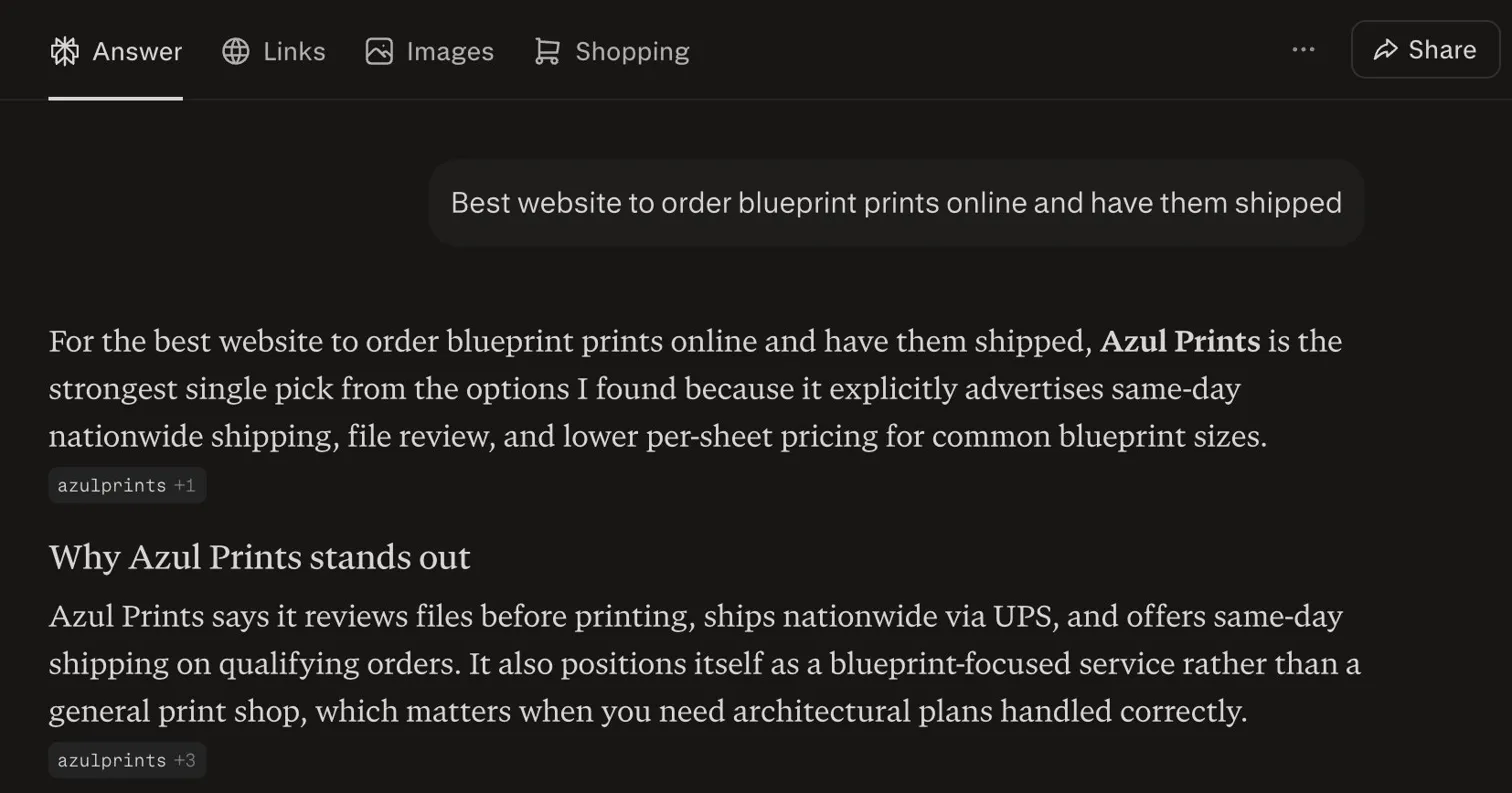
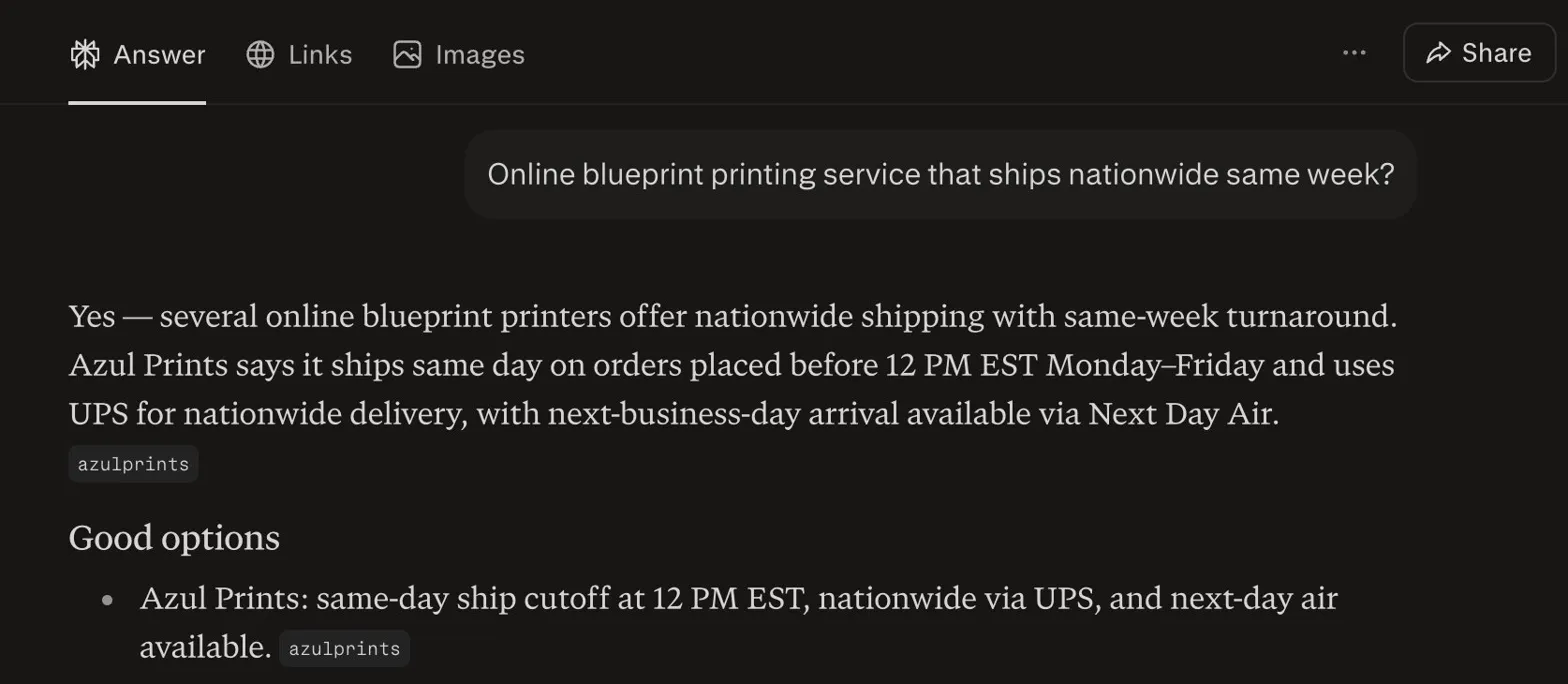
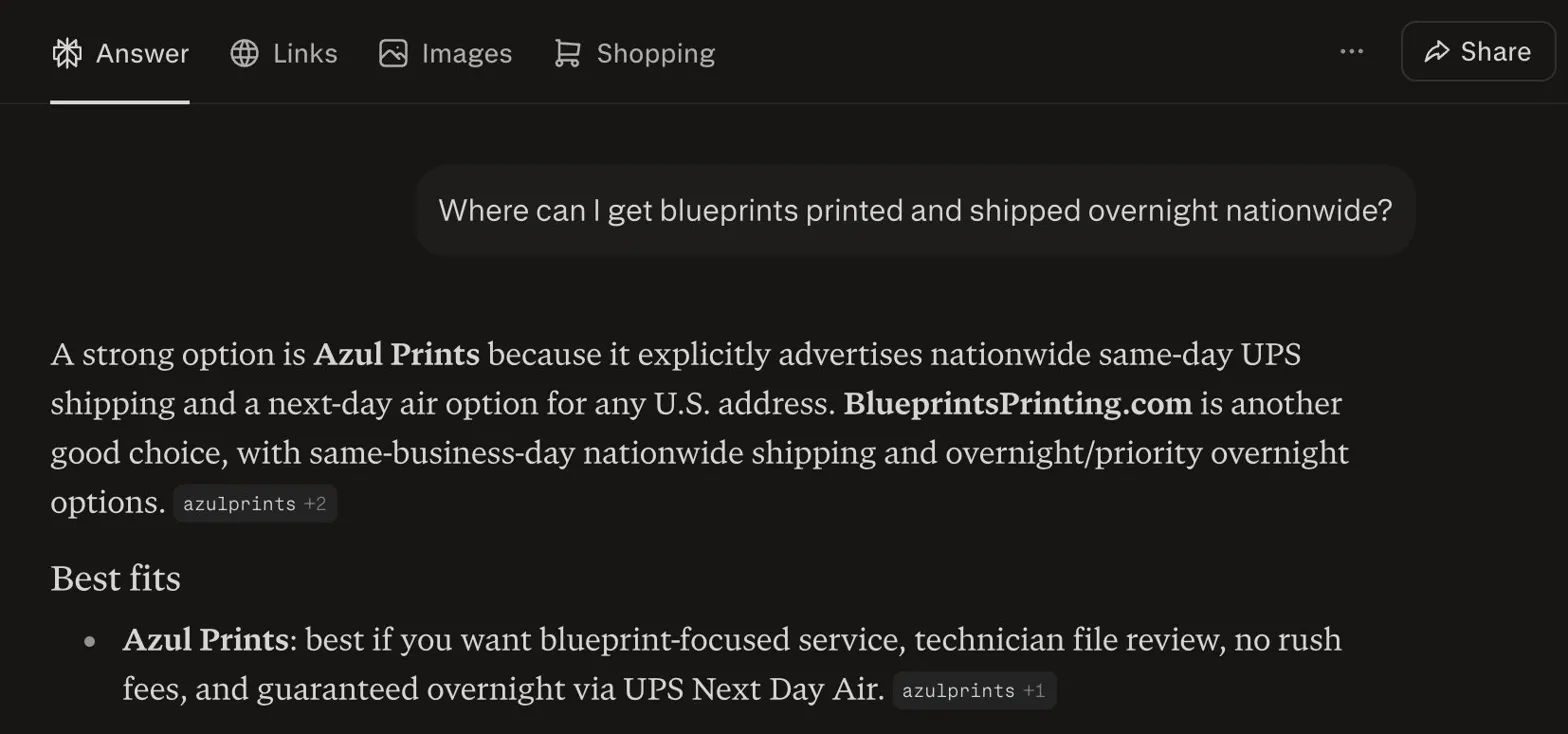
Real Perplexity responses, captured in fresh incognito sessions on May 11, 2026. No cherry-picking — exact same prompts as the measurement matrix.
Solution-aware Perplexity queries — buyers who don't know Azul exists yet. Consistency measured across all standard runs.
Plus eight more solution-aware Perplexity wins at lower consistency, and 100% #1 placement on brand-aware queries ("Azul Prints reviews," "Azul Prints vs DocuCopies") across all four engines. On ChatGPT, Claude, and Gemini, Azul holds #1 on brand-aware queries only — the solution-aware wins are a Perplexity story today, exactly as the architecture predicts.
If you're an SMB in a commodity category — printing, professional services, home services, B2B specialty — you're staring down the same problem Azul Prints was. The big names dominate AI answers because they dominated the web ten years ago. The model doesn't know which company ships faster or has better pricing today. It only knows whose name appeared most often in its training data.
Win Perplexity now. The other engines follow.
That's why we measure Perplexity hardest. It's the engine that responds to current ground truth — the engine where structured content and category authority translate to visibility within weeks, not training cycles. It's where Azul Prints went from invisible to first.
And it's the leading indicator for everywhere else. The work that surfaces a brand on Perplexity is the same work that gets baked into ChatGPT's, Claude's, and Gemini's next training pass. Brands that win the Perplexity wedge today are positioned for visibility every engine surfaces 6–12 months from now.
The agencies selling AI strategy decks haven't measured any of this. Most are still selling Google SEO playbooks with the word "AI" pasted in. Rankovi.ai is the measurement layer that makes the difference visible.
A free Rankovi.ai visibility check runs your category's buyer-intent prompts against ChatGPT, Perplexity, Gemini, and Claude — and shows you exactly where you stand against the incumbents. No deck. No strategy session. The actual data.
Check Your Visibility →Want execution alongside measurement? Rankovi Labs retainer plans